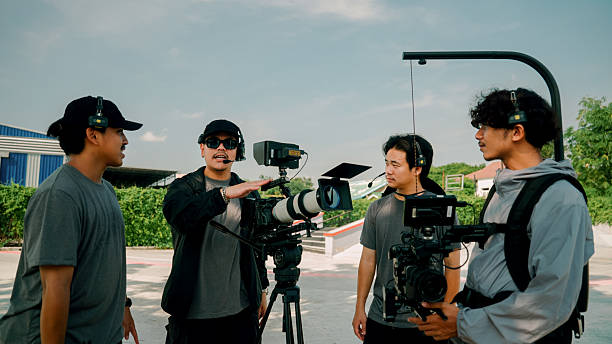

By Chris Wong — Used to think directors just yelled “action” and “cut.” Then he learned what they really do.
Last updated: June 2026
You have seen the cliché. The director sits in a chair. Wears sunglasses. Holds a megaphone. Yells “action!” Then “cut!” The movie makes itself.
This is not what directing looks like.
A movie director is responsible for turning a script into a film. They make thousands of decisions. They manage dozens of people. They work for years on a single project.
Here is what they actually do.
Before Filming Starts (Pre-Production)
Read the script.
The director reads the script many times. They form a vision for how the movie should look, feel, and sound.
Create a lookbook.
The director collects images that represent the movie’s visual style. Paintings, photographs, stills from other films. They share this with the production designer, costume designer, and cinematographer.
Hire the key crew.
The director hires or approves the cinematographer (director of photography), production designer, costume designer, editor, and casting director.
Cast the actors.
The director works with the casting director to find the right actors. They hold auditions. They read lines with actors. They make the final decision on who plays each role.
Scout locations.
The director visits potential filming locations. They decide where each scene will be shot.
Storyboard key scenes.
The director works with a storyboard artist to draw out important scenes. This helps everyone understand what the camera will see.
During Filming (Production)
Block the scene.
The director tells actors where to stand and move. This is called blocking. It happens before the camera rolls.
Work with actors on performances.
This is the part most people know. The director guides actors’ performances. They give notes. They adjust line readings. They help actors find the emotion of the scene.
| Actor Direction | Example |
|---|---|
| Emotion | “You are angry, but trying not to show it.” |
| Physical | “Look down when you say that line.” |
| Line reading | “Say it slower. Pause before the last word.” |
| Relationship | “You love her, but you are afraid to admit it.” |
Work with the cinematographer.
The director and cinematographer decide where to put the camera. Close-up or wide shot? High angle or low angle? Camera moving or still? Each choice affects how the audience feels.
Work with the crew.
The director communicates with every department. Makeup, hair, costumes, props, lighting, sound. Everyone works toward the same vision.
Make thousands of decisions.
What color should the walls be? Should the actor wear a watch? Is the lighting too dark? Should we do another take? The director answers all of these.
Say “action” and “cut.”
Yes, they do this. But it is 1% of the job.
After Filming (Post-Production)
Work with the editor.
The director and editor watch all the footage. They choose which takes to use. They decide where to cut. They shape the rhythm of the movie.
Oversee sound design.
The director works with sound designers to create the soundscape. Footsteps. Wind. City noise. Quiet. Silence. All of it is designed.
Work with the composer.
The director and composer create the musical score. They decide where music starts and stops. They choose the instruments, tempo, and mood.
Oversee visual effects.
If the movie has VFX, the director works with effects artists. They approve the look of monsters, explosions, or digital environments.
Color grading.
The director works with a colorist to adjust the colors of the entire film. Warm or cold? Bright or dark? Saturated or muted?
Final cut.
The director has final approval over the finished film (if they have “final cut” in their contract). Not all directors have this power. Studios sometimes take it away.
What a Director Is Not
| Not This | What They Actually Do |
|---|---|
| The writer | They may change dialogue, but they did not write the original script (usually). |
| The cinematographer | They tell the cinematographer what they want. The cinematographer figures out how to get it. |
| The editor | They work closely with the editor. They do not cut the film themselves. |
| The producer | The producer finds money and manages logistics. The director focuses on the creative vision. |
| The studio executive | The executive approves budgets and release dates. The director makes the movie. |
Famous Directors and Their Styles
| Director | Known For |
|---|---|
| Quentin Tarantino | Long dialogue scenes, pop culture references, nonlinear stories, violence |
| Christopher Nolan | Practical effects, time manipulation, IMAX cameras, complex plots |
| Greta Gerwig | Emotional honesty, natural performances, character-driven stories |
| Wes Anderson | Symmetrical framing, pastel colors, deadpan dialogue, detailed sets |
| Spike Lee | Dynamic camera movement, direct address to camera, political themes |
You can tell a director’s style after watching a few of their films. That is their signature.
Why the Director Gets the Credit
The director is the single unifying creative voice. The writer writes the script. The actors perform. The cinematographer lights the scene. The editor cuts the footage.
But the director guides all of them toward a single vision. Without the director, you would have great pieces that do not fit together.
The director makes the movie feel like one movie.
The Bottom Line
A director does not just yell “action.” They read scripts. Hire crews. Cast actors. Scout locations. Block scenes. Guide performances. Work with the cinematographer. Oversee editing. Shape the sound. Approve the color.
They make thousands of decisions over several years. The goal is a single vision.
Next time you watch a movie, do not just watch the actors. Notice the director’s choices. The camera placement. The color. The rhythm. The performances.
That is the director’s work.
About the author: Chris Wong watches movies differently now. He watches for the director’s choices. He finds it more interesting.
This article is for informational purposes. Director roles vary by project. The description above is a general guide.